The apparent neutron-star radius during bursts
 Measuring the radius of neutron stars is hard — ask anyone. (They're really small, and really far away; imagine trying to measure something the width of a human hair... on Pluto). The X-ray emission during the bursts seems to come from the entire surface, and is consistent with a blackbody, so it should be possible to infer the radius indirectly, but the apparent radius behaves in very unexpected ways — usually increasing or decreasing during the burst. Sudip Bhattacharyya & Cole Miller found a correlation between the slope of the radius evolution and the duration of the burst (a proxy for the burst fuel composition), based on the data from the RXTE burst catalog. Our paper was just accepted by MNRAS.
Read the paper (arXiv.org:0908:4245)
Astronomers get neutron star's measure @ ABC Science
Labels: 2009, neutron star EOS, papers, thermonuclear bursts
posted at 12:31 AM

 The annual meeting of the
 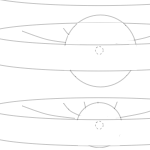 Our paper on the unusually low "touchdown" fluxes for radius-expansion bursts from high-inclination sources was just accepted by MNRAS. Usually the touchdown flux is thought to equal the Eddington flux, but we found that in sources that show X-ray dips — likely arising from structure at the edge of the accretion disk passing across the line of sight, implying that we see these systems almost edge-on — the touchdown flux could be less than half the maximum flux seen earlier in the same burst. The low touchdown fluxes also likely arise from interactions with the disk material, which have some implications for neutron-star distance (but not mass and radius) determination following the method of